Virtual Models That Drive the Real World
Causality-Aligned Simulation That Directly Commands and Controls Physical Robots
What Reverse Digital Twin Really Means
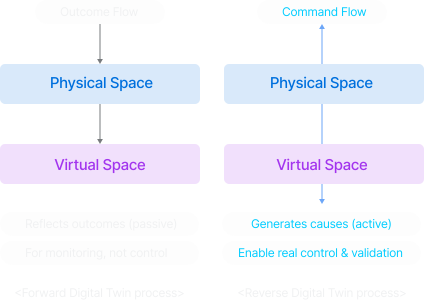
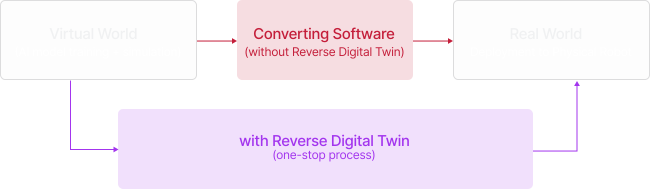
Reverse Digital Twin is a paradigm shift where the virtual environment generates and validates the exact commands that the physical robot executes, instead of merely mirroring real-world outcomes.By operating within a high-fidelity physics simulation and sharing an identical control runtime with the real robot, developers can design, test, and optimize entirely in the virtual world, significantly reducing risk and eliminating the complex sim-to-real integration gap.
Forward vs Reverse Digital Twin
RDT reverses the traditional flow of data and control, enabling proactive, guaranteed execution rather than reactive monitoring.
Foward Digital Twin
Category
Reverse Digital Twin
Core Direction
Physical → Virtual
Virtual → Physical
Primary Purpose
Monitoring & visualization
Real-time control & validation
Simulation Role
Reflects real-world outcomes
Generates causal behaviors
Data Flow
One-way stream
Two-way synchronized runtime
Control Logic
Runs only on real robot hardware
Runs on both virtual and real environments
Practical Result
Understand what happened
Guarantee what will happen
Key Benefit
Insight
Near-zero sim-to-real execution
Reverse Digital Twin's Operational Principle: Virtual-Real Synchronization
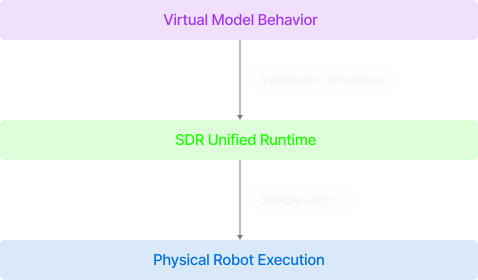
In Reverse Digital Twin, the control logic is authored and validated in the virtual environment and then executed on the real robot using the same control runtime. A continuous sensor feedback loop then ensures both sides remain synchronized for precise, closed-loop control.
Virtual Validation
All robot motions and AI models are executed and verified in a high-fidelity simulation.
Identical Runtime Sharing
The simulation environment and the actual hardware share the exact same control logic execution environment.
Sensor Feedback Loop
Sensor data from the physical robot is synchronized in real-time with the virtual model, enabling robust Closed-Loop Control.
Core Advantages of Reverse Digital Twin
Reverse Digital Twin enables a Simulation-First workflow, drastically reducing complexity, cost, and time-to-market in robotics development.
Constraint-Free AI Training
Reverse Digital Twin allows AI training entirely in simulation using accurate physical and visual data. This eliminates costly hardware setups, enabling faster, safer, and infinitely scalable model training.
Seamless Virtual-to-Real Deployment
Physics-based emulated controllers allow direct transfer of virtual models to real robots without rewriting control logic or converting APIs. This radically shortens integration time.
Risk-Free Aggressive Innovation
Developers can safely simulate edge cases, failures, and rare events in the virtual world. This enables aggressive innovation and rapid iteration without damaging expensive hardware.
Maximized ROI & Time-to-Market
Simulation-driven design and rapid iteration drastically shorten the development cycle and reduce costs, leading to maximized ROI and accelerated time-to-market.
SDR Middleware: The Foundational Layer for Reverse Digital Twin
The behavioral consistency required for Reverse Digital Twin is made possible by the SDR Middleware.
SDR Middleware provides the unified runtime where virtual models and physical robots behave identically. This consistent control layer allows validated virtual models to directly command real robots without the need for code changes or API adaptation.
Unified API
Virtual and real robots share a unified control interface, ensuring full command compatibility across simulation and hardware.
Identical Runtime
The SDR runtime executes the same logic consistently in both environments, maintaining identical motion behavior and timing.
Zero-Gap Transfer
Simulation-verified behaviors transfer directly to physical robots with zero execution gap, eliminating the traditional sim-to-real transition issues.
Ready to see the difference Reverse
Digital Twin makes?
Explore real applications, technical deep-dives, and research showing how RDT is reshaping robotics and automation.