Unified Middleware for Software-Defined Robotics
The unified layer that standardizes control, communication, and runtime—ensuring consistent behavior across all robots.
The Challenge: A Fragmented Robotics Ecosystem
Most motion editors are small extensions built inside a controller and feel limited from the start.
 Stellar Motion Studio is a complete browser-native environment designed for creating, testing, and running robot motion with clarity and consistency.
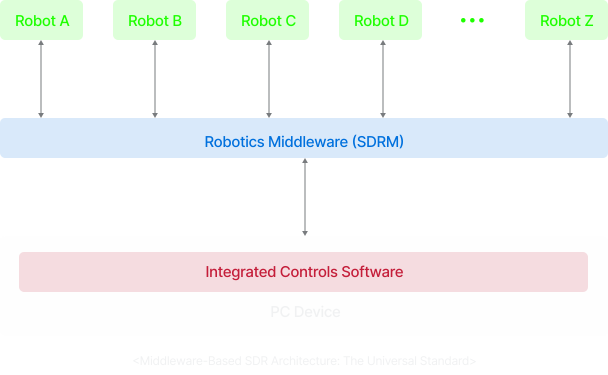
The SDR Middleware Architecture: Unified Abstraction Layer
The Software-Defined Robotics Middleware (SDRM) abstracts hardware differences and provides a unified control and communication layer for every robot. This standardized architecture guarantees a single API and consistent runtime behavior across physical and virtual systems.
Unified Control API
Provides one standardized interface for motion, I/O, state handling, and robot operations across all hardware types.
Hardware Abstraction Layer
A unified layer that normalizes different controllers, protocols, and electrical interfaces, effectively decoupling control logic from hardware.
Virtual–Real Consistent Runtime
Ensures the same logic executes consistently in simulation and on hardware, guaranteeing behavioral consistency across environments.
The Shift: From Hardware-First to Software- First Development
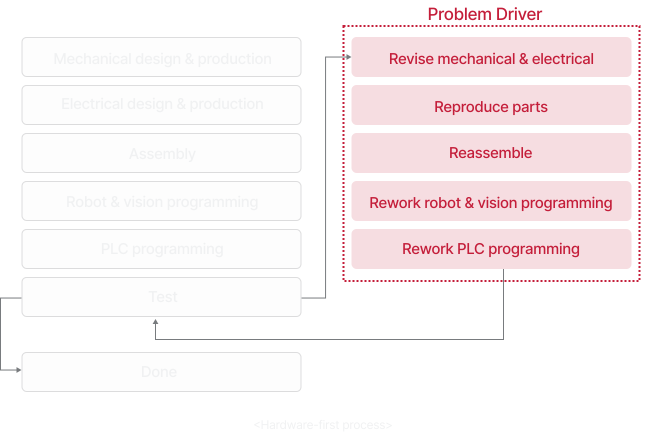
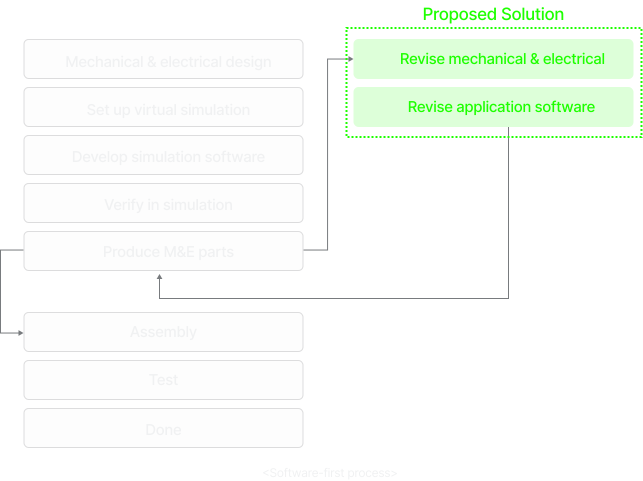
Legacy robot development tightly binds control logic to hardware, demanding physical robots for all integration, testing, and validation. SDRM decouples software from hardware, enabling a faster, repeatable, and scalable Software-First development workflow.
Legacy (Hardware-First)
SDR Middleware (Software-First)
Development Start
Must wait for hardware installation
Control logic built and tested before hardware arrival
API
Custom drivers and integrations per robot
One standardized Unified API across all robots
Code Reusability
Motion logic often rewritten for each project
Logic is written once and reused across platforms
Debugging
Issues found and fixed only on real hardware
Identical-runtime testing matches real hardware.
Iteration Speed
Slow, expensive hardware-first loops
Fast, scalable, simulation-first iteration
Four Primary Advantages of SDR Middleware
SDR Middleware eliminates inefficiencies and maximizes productivity in robot development and deployment.
Unified API Across All Robots
One interface for motion control, communication, and state handling, regardless of robot brand or hardware.
Reusable Logic & Rapid Integration
Robot programs, drivers, and motion logic work across different platforms without rewriting code, drastically cutting integration effort.
Virtual–Real Consistency
The identical runtime behavior in simulation and hardware enables reliable testing and trusted virtual-first workflows.
Hardware Decoupling for Scalability
Control logic is independent of specific robot models, making system updates, expansions, and fleet management significantly easier.
SDR Middleware: The Enabler for Reverse Digital Twin
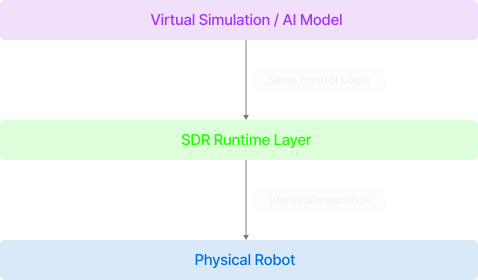
SDR Middleware provides the unified control layer that ensures physical and virtual robots operate identically. This consistent runtime environment is the foundation that makes Reverse Digital Twin possible, allowing virtual models to directly and reliably command real robots.
Unified API
Virtual and physical robots use the same control commands and interface, eliminating the need for separate sim-specific or hardware-specific code.
Identical Runtime
The same control logic runs with identical timing and behavior in both simulation and on hardware, ensuring consistent execution.
Zero-Gap Transfer
Models validated in simulation can run instantly on physical robots with no tuning or sim-to-real mismatch.
Unlock Software-
First Robotics with SDR Middleware
SDR Middleware is the integrated control layer that ensures consistent behavior, making Sodero's virtual platform and Reverse Digital Twin technology a reality.